Can You Legally Use a Brand's Logo?
Filed under Business
Downloading a brand's logo is easy. Knowing whether you are allowed to put it on your website is the part that makes people hesitate — and rightly so, because the answer is not simply "it is free, so it is fine".
This is general information to help you ask the right questions, not legal advice. For anything commercially significant, talk to a lawyer in your jurisdiction.
Two different rights are involved
People tend to say "copyright" for everything, but logos usually involve two separate protections, and they work differently.
Trademark protects a mark as an indicator of commercial origin. It exists so that when you see a logo on a product, you can trust it tells you who made that product. Trademark is about confusion: the question a court asks is whether your use is likely to make people think the brand is behind your goods or services.
Copyright protects the artwork itself as a creative work. A highly stylised logo may qualify; a plain wordmark in a standard typeface often does not, because it lacks the originality copyright requires.
The practical consequence: even when copying the artwork is not a copyright problem, using it in a way that misleads people about who is behind something can still be a trademark problem.
Uses that are generally acceptable
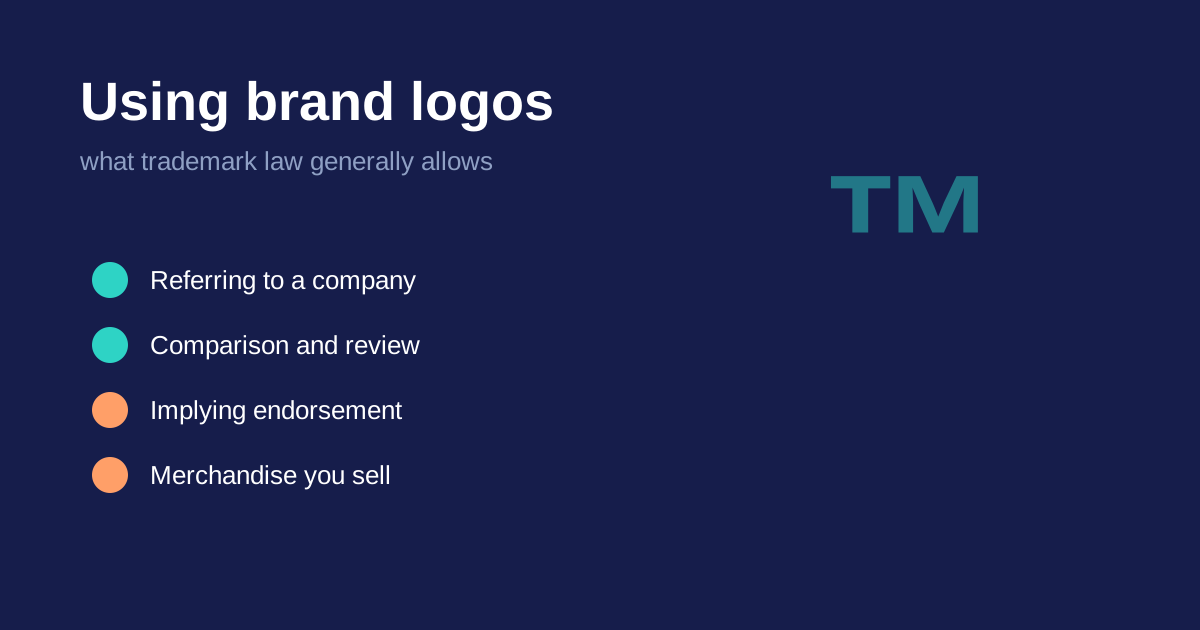
Most jurisdictions recognise that you sometimes have to use a company's mark simply to talk about that company. In US law this is broadly called nominative fair use; other countries reach similar results by different routes. Typical examples:
- Editorial and journalism. An article about a company can show its logo.
- Comparison and review. Comparing products, listing competitors, benchmarking.
- Compatibility and integration. "Works with X", "imports from Y" — as long as the styling does not suggest X endorsed you.
- Client and partner lists. Showing who you have genuinely worked with, accurately.
- Education and reference. Teaching materials, design case studies, logo histories.
The common thread is that you are referring to the company, not borrowing its identity.
Uses that cause problems
- Implying endorsement. Placing a logo so it reads as a sponsor, partner or approver when no such relationship exists. This is the single most common mistake.
- Merchandise. Printing a brand's mark on things you sell — shirts, stickers, phone cases, mugs — is straightforwardly infringing, whatever the file was free to download.
- Your own branding. Using someone's mark, or something confusingly close to it, as your logo, app icon, avatar or domain.
- Altering the mark. Recolouring, stretching, adding to or cropping a logo. Brands consider their marks fixed, and distortion is both a trademark issue and a reliable way to annoy a legal department.
- Suggesting affiliation in a name. "Official", "certified" and similar words attached to a brand you have no relationship with.
Check the brand's own guidelines first
This is the step most people skip, and it is the most useful one. Large companies publish brand guidelines that state plainly what they permit — minimum clear space, which colour variants are allowed, whether you may use the mark in a partner context, and who to ask if you are unsure.
Search for the company name plus "brand guidelines", "brand assets" or "press kit". If a brand has written down that a use is acceptable, you have a much better position than guessing. If it has written down that a use is not acceptable, you have saved yourself an awkward letter.
Practical rules that keep you out of trouble
- Use the official mark, unmodified, at a reasonable size.
- Do not make a brand's logo more prominent than your own.
- Say what the relationship is, accurately, in words — and never imply one that does not exist.
- Add an attribution line where it helps: "X is a trademark of X Inc."
- If a use is commercially important to you, get it checked rather than hoping.
What "free to download" actually means here
When we say a logo is free to download, we mean exactly that: there is no charge, no account and no watermark on the file. It does not mean the mark is unowned, and no download site can grant you rights it does not hold. The trademark stays with the company that owns it.
That is not a reason to avoid using logos — it is a reason to use them the way they are meant to be used. Referring to a company, comparing products, writing about design, building a compatibility page: all normal, all fine. Putting someone else's mark on merchandise: not.
If you want to browse what is available, the category index covers everything from banking to vector marks of all kinds.